

Between the Seas
A story by Mays Kuhail

Order the Winter 2026 issue of Nimrod International Journal or subscribe today.
Nancy Jooyoun Kim awarded Mays Kuhail second place in our annual Katherine Anne Porter Prize for Fiction competition, calling “Between the Seas,” in which a group of childhood friends make two visits to the beach, a “quiet unsettling story carved by the gray emotional and moral borders drawn when documents define and circumscribe our experiences.” The judge’s statement concludes, “With its uncomplicated, direct prose in the present tense, this spare and elegant story deftly explores the Herculean emotional and moral contortions we all participate in when we deny or circumnavigate the center of what makes us essentially, and beautifully, the same.”
We are honored to share the story, which appears in our Winter 2026 issue, with you now.
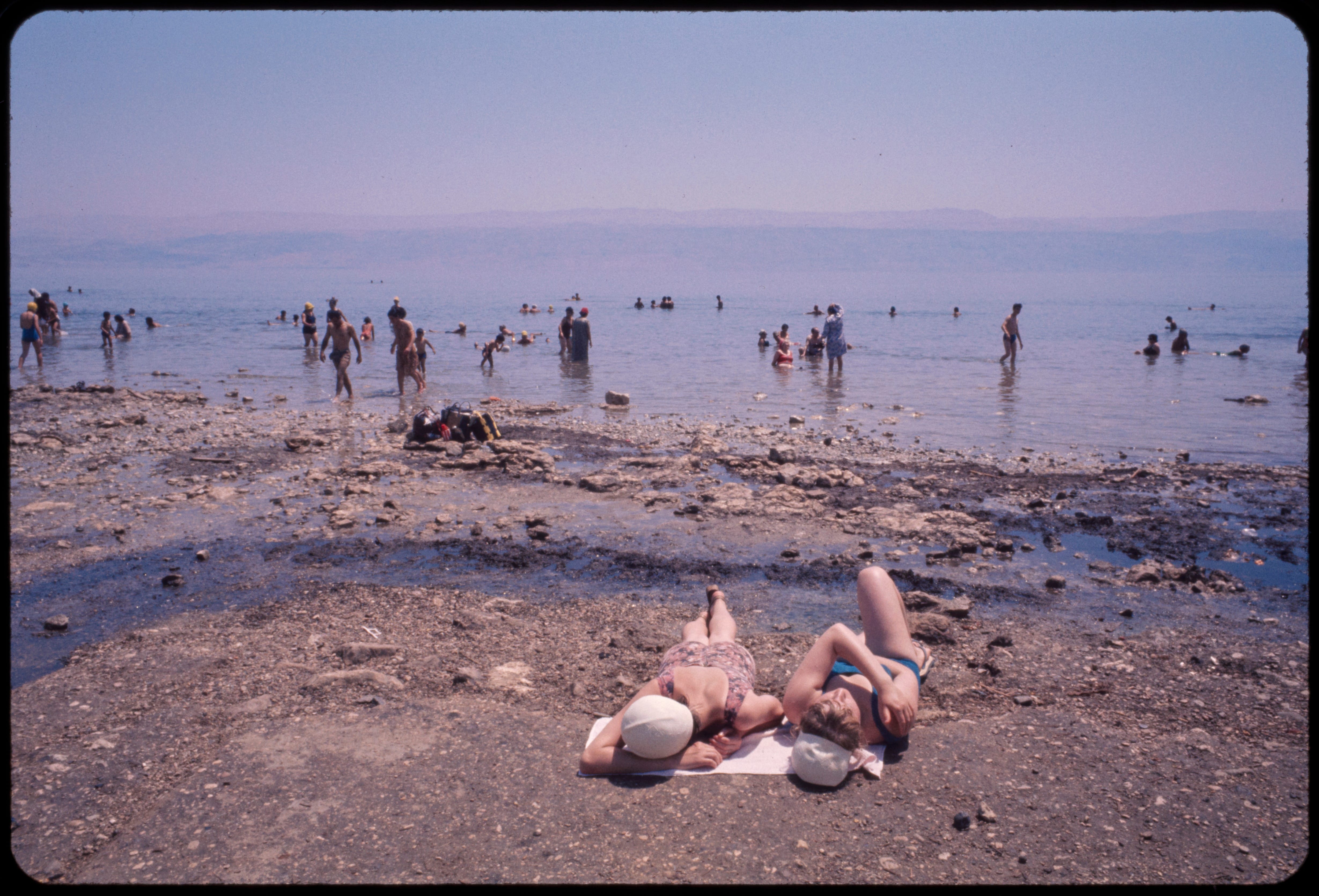
My friends and I go to the Dead Sea instead of the Mediterranean. It’s the only sea we are all allowed into. There’s traffic on the highway to Jericho. We should have taken the Mo’arajat, but Peter did not feel like he’d have good command over the winding desert road. We slow down to an almost stop, 20 km/h. Peter’s foot is heavy on the brakes. He doesn’t take criticism well, though, so I don’t mention it. To our right, I spot the sea level marker sign. A stone structure on the side of the highway. Carved in blue are the words “Sea Level” in Arabic, English and Hebrew.
Traffic subsides once we pass the exit leading to a nearby settlement. Peter speeds up and turns up the volume to Adele’s “Make You Feel My Love.” I extend my arm out of the window and push against the wind. I can feel the temperature rise as we near the Jordan Valley. I bring my arm back inside and roll my window up. I look back to Arlene who somehow, despite Peter’s off-key rendition of Adele’s song, is able to focus on her sudoku puzzle. She looks up from her phone and smiles, then refocuses. Peter and I hadn’t wanted to go, especially not in May. It was Arlene who’d talked us into it when Omar suggested we all go to the “sea.” Omar, whose Akkawi body has never seen or touched the Mediterranean. It was my guilt that drew me to say yes and fear of missing out that drove Peter to join. I gaze toward the rows of Palm trees as we near the intersection leading to the Dead Sea, they line perfectly against Jordan’s hills. Peter points out the glisten of the waters, which, from the distance, looks like a lake. I catch myself wishing for the day to go by quickly. A few Bedouins herd their sheep to our left. I remind myself that it’s okay not to have wanted to come. I move my jaw sideways to pop my ears. We’re well below sea level now.
Our friend group is divided between Jerusalem residents, West Bank permit holders, and West Bank non-permit holders. Peter is from Jerusalem, Arlene has a permit through church, and I have a work permit, but Sarah and Omar don’t have access to the occupied territories. We can only meet outside of the Green Line. We carpool in two cars. Peter, Arlene, and I, in one car, and Sarah and Omar in the other. We each pay the ₪67.5 entrance fee and walk down boardwalk steps toward the Kalia beach shore. Halfway there, we pass by a small shack with a sign that reads “The Lowest Bar in The World.” Peter shoots me a playful look and mouths Cocktails? Maybe a cocktail would help with the fact that I can barely breathe in the 42° C heat. Clouds mesh with the sky. The opaque blue traps the heat, makes the temperature almost painful.
We get to the beach and grab some plastic chairs. Sweat trickles down our bodies. Arlene’s makeup melts. I trace a line of sweat in her makeup, distinguishing her skin tone from the foundation shade she wears. We begin to undress down to our bathing suits. I wish for a breeze to cool the sweat on my body and a breeze does come, but it feels like air from a blow dryer. The murky body of water is outlined by a firm rocky surface and several pockets of mud. From our end of the shore, I spot the Jordanian hills.
“Let’s go into the water,” Peter says.
“You know it won’t be refreshing, right?” I respond.
“It’ll help some,” Arlene pinches me. “Let’s go.”
Omar stands by one of the pockets of mud, and helps each of us into the water. One of my feet slips, but Omar holds my arm and I make a safe landing into the sea. It’s as warm as a jacuzzi. It makes the heat worse. Peter follows with a bag of chips in his mouth. He lets the salt levitate him and takes a few seconds to balance himself. He opens the bag of salt and vinegar chips, and begins to crunch.
“Want some?”
“Your snack choices are quite interesting, Peter,” I say. “I can’t eat salt and vinegar in the heat.”
“What does heat have to do with chip flavor?”
“It’s the equivalent of smoking a cigarette when it’s hot.”
“Mm, I see your point,” he crunches on another chip and grins. “Kinda.”
Arlene winces. I take a few steps toward her, the dense water resists my movement.
“Are you okay?” I ask.
“I shaved my legs this morning,” she says. “Like an idiot.”
“Shit. Sorry. Give it a few minutes. The salt burns will ease.”
Sarah opens the cooler and tosses us some drinks. I grab a Diet Coke. The tab breaks under my nail but I get the can to open. I gulp and feel the chill move through my body, but it passes before I can enjoy it. I take another sip. Sarah sits under an umbrella and watches us while braiding her hair. I could tell she didn’t want to be there, either. She must have done it for Omar, too.
“Yallah ya Sarah,” I smile, calling her into the water.
“Yallah,” she smiles back.
She takes her slides off and jumps from one hot rock to the other. She slips into a pocket of mud and falls on her ass, submerging herself into mud. We all break into laughter. She breathes out fuck it, and holds a wet lump of mud and throws it at me. It lands on my belly. I smudge it across my body, lean into the water to grab a clod then throw it at Omar. The fight scales to the five of us. Within minutes, we are properly covered with mud. I make sure to get some on my legs where my eczema usually flares up. For a moment, I forget about the heat. We all do, I think.
“We shouldn’t stay here for long,” Omar checks his phone after a couple of hours. “UV index is high, don’t want anyone to leave with a sunburn or a heat stroke.”
Peter exhales in relief.
We “swim” for another half hour, and pack our stuff to leave back to Ramallah. Sarah and Arlene ride back with Omar, and I drive back with Peter. We hug goodbye, and agree to go out with Omar and Sarah next week prior to their engagement party.
“Thanks for humoring me and Omar,” Sarah smiles as she clasps his hand. “We’re glad we got to spend the day together.”
Arlene, Peter, and I join in echoes of course, and no, we had a great time.
Peter, Arlene, and I get off the highway through Hizma and into Kufr Aqab, a Jerusalem neighborhood severed from the city by the wall. The neighborhood remains under Israeli jurisdiction, but the Jerusalem municipality has given up all responsibility and the Palestinian Authority has no rule in the area. The result: no man’s land. Contractors build near skyscrapers, with no licenses. Drug dealers use it as a base for business. Merchants sell and price products the way they see fit. A coffee seller has set up a small business on a slab of concrete that’s fallen next to the checkpoint. We pass by a (fake) Chanel store tucked between a hookah shop and a (fake) Nike store before we turn right up the hill to Peter’s house in Kufr Aqab, a few kilometers south of Ramallah. We’ve both watched his neighborhood transform like a time-lapse video of a sunset. Quick. Fleeting. Our friend group had grown up going to Peter’s house after school. We used to bike across the hill and play with the stray cats. We’d come back to his house for dinner, always making sure to bring auntie Nahla, his mom, some poppies. She would smile and thank us, but would always say:
“Poppies belong to the Earth.”
We eventually stopped. There were no more poppies to pick. The mass of apartment buildings had hollowed out the earth and risen into the sky. The sun doesn’t enter any of the rooms in Peter’s home anymore.
A few months ago, Peter got a tattoo of a poppy. When he showed it to me, I thought poppies belong to us, too.
The streets overflow with garbage. Bags of moldy bread hang on the sides of dumpsters. I crack the window open and smell a combination of car exhaust and cigarettes. I think about a world in which poppies still bloomed in the neighborhood’s hills.
Peter drops me off at his house to pick up my car. Auntie Nahla greets me at the gate and insists I come inside for tea.
“I found calamint the other day,” she smiles, proud to have acquired the rare seasonal herb.
“You know it’s my favorite!” I jump out of the car and rush into their house.
Auntie Nahla walks into the living room with mugs of calamint tea with some zucchini bread.
“I made mahshi today and used the core to make this cake. Should I pack you a plate for you and your mama?”
“I know mama would love that, Auntie. Thank you.”
“How was your day? Did you have a good time?”
“I wouldn’t say that swimming in the Dead Sea is my activity of choice,” I pick at my cuticles. “But it was nice to spend the day with everyone.”
“I tried to bring the vibes,” Peter says. “But the heat and the mud and the stickiness…”
“And you drown if you try to swim,” I remind him of how he did unintentional somersaults and burned his eyes in the water.
“Peter!” Auntie Nahla clutches her shirt.
“Mama,” he motions to himself, indicating the fact that he’s here and hasn’t in fact drowned or choked on salt water. “I’m fine.”
“Let’s go to Yafa tomorrow. Me, you, Arlene?”
“And Omar and Sarah?”
“Don’t get started,” Peter says. “We yielded to the group’s request today. We owe it to the people who can’t have fun to have fun on their behalf.”
I stare at him, my anger surfaces closer to my skin.
“That’s bullshit,” I say, raising my voice. Auntie Nahla bites her lip. “Sorry, Auntie.”
“You know what I mean,” Peter clasps his hands in front of him. “Plus, we only have a few more weeks before jellyfish season.” Peter has a jellyfish tracker app on his phone. He refuses to go to the beach during high jellyfish activity.
“It’s not like you have a choice on who gets to go,” Auntie Nahla says, “and who doesn’t.”
I stare into my tea.
She was right. None of us have a say in our ID and permit “privilege,” but I don’t know if we owe it to anyone to go on their behalf. If we go, it’s out of pure hedonism.
“Let me text Arlene,” I finally say.
Yafa tomorrow?
Why?
Long weekend. Make use of the extra day.
Hm. I’d kinda feel bad …
I was thinking the same thing :/
“What is she saying?”
“I think she’s having similar hesitations.” I lock my phone and mumble, “Owe it to Omar and Sarah.”
“You know what?” Peter raises his voice, his tone less humorous. “We don’t owe it to them, or anyone.”
My eyebrows furrow. I rarely see him get worked up.
“We owe it to ourselves. I owe it to the fact I’m stuck living in this neighborhood. Amid the construction dust that never seems to settle. The persistent traffic. The noise that won’t break. Windows so close to those of our neighbors we practically drink our morning coffee together. All to maintain our Jerusalem ID. Might as well make use of it, enjoy its perks. And you,” he paused. “You owe it to the fact that you’re the first person in your family to get a permit.”
Auntie Nahla nods. “I don’t agree with my son about a lot of things,” she smiles while squeezing my shoulder. “But he’s right about this.”
I don’t know if I’d survive life in Kufr Aqab. I think Peter’s used to its chaos. Seeks it out if it’s not there, demands peace from it when it is. I don’t know if it was the pressure of jellyfish season approaching, or if I was beginning to agree with Peter and Auntie Nahla, but I hit send on the text to Arlene.
Don’t unpack your beach bag.
We agree to leave at noon the next day.
The coast is a feeling.
I pick up Arlene to park my white-license-plate Mazda in Peter’s garage again, and we ride in his yellow-license-plate Subaru to Yafa. Peter has to drop us off at Qalandia checkpoint so we can pass on foot since we, non-Jerusalemites, can’t cross in the car. We walk into the checkpoint building through a maze-like pathway that spirals into two turnstiles. I count at least four new security cameras. We stand in line at a turnstile of our choosing. We choose left, the line seems to be moving faster. Arlene begins to tap at her forehead. Despite having done this countless times, she always gets anxious. I, on the other hand, disassociate as I endure what has now become a routine process. The turnstile has a traffic light. When red, the turnstile is jammed. When green, it lets three to five people in at a time. Arlene and I get to go in the same cluster. We place our bags on the security machine and walk into the body scanner. Neither of us trigger the scanner’s alarm. I hear an old man explain that he has metal in his body from a knee surgery while a soldier pats him down. I pull out my ID and a screenshot of my permit and Arlene does the same. I line up to show my documents to the soldier in the glass box. I press them against the glass. He clicks his keyboard and then nods. The turnstile is jammed. He says try again, and this time, the turnstile turns. Arlene follows. I notice her fingers trembling as she places her documents back in her purse. It only takes thirty minutes today. I hold Arlene’s hand to cross the bridge to the other side. Impatient, I start to pace to Peter’s car. Arlene squeezes my hand, reminding me to walk slowly, not run. No sudden movements lest we alarm soldiers in the watchtowers. Peter waits for us on the other side of the wall.
I smell fresh fish down the port. I stop to look at crabs trying to make their way out of a green plastic bucket. The fishermen chat about the waters, how they’re abundant this week. Must be the currents, they note. Their bodies are relaxed. I wonder if it’s the proximity to water that makes coastal bodies mellow. I gaze at the turquoise water, the clear skies, and the steady line between them, stretching the horizon open. My body loosens into the air.
We ride electric scooters from the port to the beach. Peter’s going full speed, and Arlene and I ride behind him, remarkably slower.
“Yallah,” he yells.
“Shwai shwai,” I yell back.
Sand grains tickle my toes. I wade into the water, my weight loosens beneath me. The Mediterranean sizzles on my skin. I walk slower. Peter runs behind me and splashes me. My body is fully wet now, so I dive into the water and keep my arm up to flip Peter off. I hear his faint laughter as I swim toward the horizon. I sense the contrast in the water’s temperature, its surface warmed by the sun, while its depths remain chill. I submerge myself again and float on my back, slowly moving my arms up, then toward my hips. Back to my head. Hips. I open my eyes to the sun and find myself deep into the sea. The waves are calm today. I let them slowly guide me back to the shore.
“That felt fantastic,” I tell Peter and Arlene, who compare shells they’ve dug out of the sand. Arlene had brought thread to make bracelets. She lays the shells on her leg in a straight line.
“Then why are you frowning?” Peter asks.
“There’s no one to start a mud fight with.”
“There’s no mud here.” Peter clumps some sand and throws it in the air. It falls back into his eyes. Idiot. “Can’t throw sand in each other’s eyes.”
I hand him a water bottle to rinse his face. “You know what I mean.”
Arlene changes the conversation. “Do you think it’s genetic?”
“What is?”
“Affinity to the water, the coast?”
“Please,” Peter says. “You were born in Ramallah,”
“Yeah, but my grandparents are from Haifa.” She continues to inspect shells for holes big enough for the thread.
“Hm,” I say. “Both of my parents are from Bethlehem but I don’t think I necessarily belong in the valley.” I think about Omar, whose family lived in a house by the water prior to 1948. Does his skin crave the humid air? Would he feel it fill the pores in his skin?
“Okay ya bent el sahel, coast girl,” Peter says, nudging my shoulder. “Let’s get some food.”
We walk to a nearby restaurant. Peter orders the seafood pasta. Arlene asks for crab. And I get the fried fish.
“You should get some sea salt hair spray,” Arlene tucks one of my curls behind my ear. “Your hair looks beautiful.”
I crunch the salt out of my curls. We watch the sunset from the restaurant patio.
“Did you know that it takes less than a minute for the sun to dip behind the water once sunset starts?” I say.
“Could be the longest or shortest minute,” Peter exhales. “Depending on your perception.”
I roll my eyes at him. “Stop trying to be deep.”
“Look,” he points toward the horizon.” It’s halfway into the sea and you’ve wasted half of your minute arguing with me.”
I don’t respond. Instead, I choose to listen to Peter and make the next thirty seconds count. The sun dips behind the orange crests. I grab my phone and take a picture.
“Now it’s eternal,” Arlene says. She leans her head into my shoulder.
“I’ll send it to the group chat,” I say. “Share the moment with them.”
“Wait.” Peter pauses. “Should we tell them that we were here?”
“I don’t know,” I say.
I follow the last sliver of sunlight as it sinks into the sea. Perhaps Peter was right. Perhaps today belonged to us. At this moment, I realize that I, myself, had forgotten about Omar and Sarah for most of the day. I recall the time we went cherry picking in the Golan Heights without them. We hadn’t brought any cherries back. Sarah had spotted the scarlet stains on my white tank top, but hadn’t said anything. Would she smell seaweed on me this time? Would I be able to wash it off my skin?
“I don’t know,” I repeat. I bite the inside of my lip until I taste metal.
We saunter to Peter’s car, drowsy from our meals and sunburns. I stare at the sea as we back from the parking lot. I pause to savor it. I take a deep breath, inhale the salt air. I exhale and roll my window up knowing my next breath would be that of the mountain. Far from the coast.
I hear rattling in the back seat and I look to Arlene, who’s fidgeting with something.
“What’s that?” I ask.
She opens her palm and reveals two shell bracelets.
“For Omar and Sarah.”
The water’s crests catch the moonlight, shimmer in the dark. We merge onto the highway. The sea falls from the rearview. Peter hands me the aux cord, but I don’t queue any music. We sit in our silence for the rest of the drive home.
Mays Kuhail was born and raised in Ramallah, Palestine. Her writing grapples with nostalgia and memory, generational trauma, spatial politics, hope, and joy. Mays holds an MFA in Creative Writing from Bowling Green State University. A 2025 Best of the Net nominee, Mays’ work appears in SoToSpeak, Fahmidan, and Phoebe Journal.
Order the Winter 2026 issue of Nimrod International Journal or subscribe today.