

Borges and “Borges”
An essay by Esther Allen


Order the Winter 2026 issue of Nimrod International Journal or subscribe today.
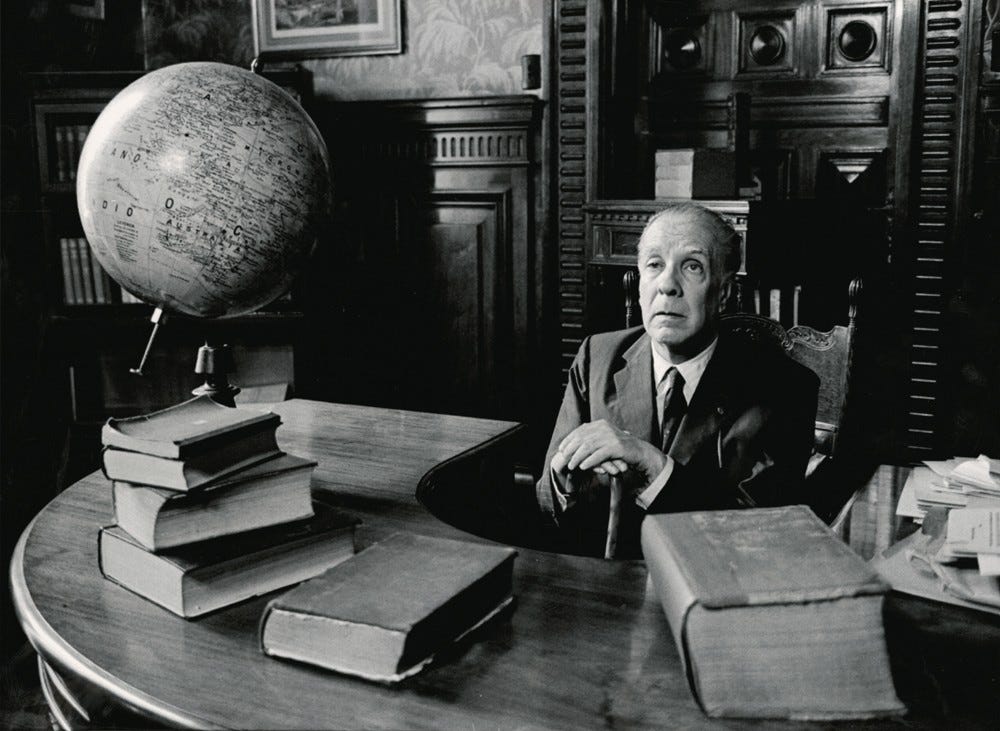
          “A New York cab driver who fought in World War II
          and Vietnam told me: I hate memory.”
                — Jorge Luis Borges to Adolfo Bioy Casares, April 13, 1980
Thirteen years ago, while translating Jorge Luis Borges, I committed a blunder so colossal that my translation was never published and I never again translated anything written by Borges.
Had I actually been translating something written by Borges, though? The book I was working on, Borges Profesor, was based on transcripts of recordings made by students in a course on English literature Borges taught at the University of Buenos Aires in 1966. It was first published in 2000, fourteen years after Borges died. Its words may have been uttered by Borges, but it wasn’t written by him the same way he wrote, say, “Tlön, Uqbar, Orbis Tertius.” Translating an essay such as “The Translators of the 1001 Nights” (as I had) was a different experience from translating a transcript of the gentle ramblings an aging professor had been delivering for decades. In that sense, Borges Profesor was more like the twenty-odd books of interviews with Borges. Or—though it’s in a different class all its own—like the monumental 2006 Borges, a 1,600-page compendium of diary entries kept by his lifelong friend and collaborator, Adolfo Bioy Casares.
The stage for my colossal blunder was set a couple of years earlier when, with New York Review Books, I agreed to undertake an English translation of Bioy Casares’s Borges. With its half-century of friendship, soaring flights of erudition, debate, gossip, literary and political intrigue, and philosophical reflection, Borges may be the single most intimate, unflinching, detailed, insightful, delightful, and sustained record of one writer’s life, thought, and conversation ever made by another, a massive and peculiar masterpiece akin to James Boswell’s 1791 Life of Johnson and Johann Peter Eckermann’s 1836 Gespräche mit Goethe, both of which inspired and shaped it and are often discussed in its pages.
However, after a long period of negotiation—during which I secured a fellowship at the Cullman Center for Scholars and Writers at the New York Public Library to work on the translation—NYRB was unable to acquire rights. Copyright in Bioy’s literary work is held by Fina Demaria, a former mistress of Bioy’s and the mother of his son Fabian, one of the heirs named in Bioy’s will. When Fabian died in 2006, rights reverted to his mother, who has entrusted all decisions regarding the publication of Bioy’s literary work to Daniel Martino, Bioy’s friend and amanuensis, who met him in 1986, the year Borges died, and who edited Borges, oversaw its publication, and organized its indispensable 129-page digital index. What brought negotiations to a halt was the question of abridgement. Martino had already edited a 691-page version. Given the immense wealth of material related to British and US literary culture in the full-length Borges, our aim was to create a different abridgement, made specifically with the English-speaking world in mind. In early fall of 2009, Martino made it clear that would be unacceptable.
One of Borges’s most celebrated prose poems muses on the difference between Borges and “I,” the speaker, who lives and lets himself go on living “so that Borges may contrive his literature,” as James Irby’s translation has it. “I” is the living body that strolls, drinks coffee, converses, and reads books. Now that that body is no longer alive, “I” may also seem to refer to the twenty-odd books that record Borges conversing, answering questions, chatting, and being more or less his own spontaneous first-person self—or perhaps, as the poem confesses, impersonating himself, or perversely “falsifying and magnifying” himself.
In retrospect, the vague lumping of all these books into a single category—records of Borges’s speech as opposed to written texts composed by Borges—was the origin of my problem. What really mattered was not some theoretical oral alikeness they all shared but a far more crucial distinction in plain view on their copyright pages. Most interviews with Borges are copyrighted to the publisher or interviewer, just as Borges belongs to the Bioy Casares estate. The transcribed 1966 course on English literature, however, was copyrighted to the late María Kodama, who, until her death in 2023, was Borges’s literary executor and the founder and head of the Fundación Internacional Jorge Luis Borges. Kodama died without leaving a will. After a period of uncertainty, control of the Fundación went to the five adult offspring of Jorge Kodama, her lone sibling, with whom she appears to have had almost no contact. (When an interviewer asked her about her brother eight years ago, she replied, “Let’s just say I’m an only child.”) For more than a year after her death, the Fundación’s home page continued to declare in bold block letters that it was dedicated to “promoting the correct interpretation” of Borges’s work. That statement has now been removed.
When New Directions asked me to translate Borges Profesor, I was glad of another chance to continue the work with Borges I’d begun more than a decade earlier with the Selected Non-Fictions of Jorge Luis Borges, edited by Eliot Weinberger, who invited me to translate a number of the pieces it includes, which were annotated by Weinberger. To make Professor Borges more accessible to its new audiences, the New Directions editors and I felt some additional annotations were in order there, as well.
I checked the 2006 French edition, translated and prefaced by the Borges scholar Michel Lafon; its inclusion of a good number of “Notes du traducteur” seemed to indicate flexibility and a willingness to work cooperatively on the part of the two Argentine researchers who had collected and transcribed the tapes and edited and annotated the transcripts. I emailed one of them, Martín Hadis, to introduce myself and discuss the possibility of revising the footnotes. He replied right away, agreeing that this would be useful. Wary of email, and eager to ensure a cordial working relationship, I secured a grant to fund a summer 2011 research trip to Buenos Aires that would allow me to work on the new annotations with Hadis in person.
The Hudson Review had requested an early excerpt to include in a Spanish issue they were preparing for spring 2011. I chose the seventh class, in which Professor Borges “speaks of God’s two books, the Anglo-Saxon bestiary, the riddles, ‘The Grave,’ and the Battle of Hastings.” This would also be a chance for a trial run on revising the annotations.
I’d spent many hours exploring the forking paths of reference that Borges’s work sends its readers down and was glad of another chance to wander through that crepuscular garden. Professor Borges rarely alludes to his own writing in his class lectures, but the literary works and figures he evokes are invariably woven into his essays and fictions, and the network of connections between his pedagogy and his Complete Works is a glittering outline of literary history refracted through his mind. The existing annotations to Borges Profesor often pointed out such echoes. When Professor Borges brings up the Old English alliterative poem “The Panther,” a footnote adds that this poem is cited in his and Margarita Guerrero’s 1957 Book of Imaginary Beings. I saw an opportunity to expand on that.
There were innumerable links to observe between Borges’s classes and the conversations Bioy recorded in his diary, which sometimes happened only a few hours after Borges emerged from the classroom. I presumed that these went unmentioned in the original notes to Borges Profesor because Borges came out six years later. Translating the transcribed classes would, I thought, give me a chance to go back to Borges and use it to further illuminate the lectures.
The Hudson Review had no space for a preface, so a footnote on the first page of “The Seventh Class” used a citation from Borges instead. In April 1960, Bioy asks Borges what period he likes best in his courses on English literature, and whether one century is his particular favorite. Borges rejects the question and underscores the difference between conversation (talking, teaching) and reading (or writing). “It’s clear one does not always prefer to talk about what one prefers to read,” he replies. “I spend my life reading Gibbon but prefer to talk about Francis Bacon.” He goes on to hail Bacon as the thinker who “noted the deficiency of a history that took only monarchies and battles into account” and called for histories of every form of knowledge, including literary history.
The forty-fourth footnote, on Heinrich Heine, alludes to Borges as well. In May 1965 Bioy’s diary records Borges saying, “Heine, a more inspired and intense poet than Goethe, would never have acknowledged that superiority.” Ranking writers according to abstract categories of greatness was something Borges and Bioy loved to do in conversation. Borges’s writing, though, is more likely to subvert the hierarchies of literary fame, “a form—perhaps the worst form—of incomprehension,” he wrote in “Pierre Menard, Author of the Quixote,” as translated by Andrew Hurley.
When The Hudson Review came out, I emailed the chapter to Hadis, who was duly credited, along with his partner Martín Arias, as editor and annotator.
For the next few days I remained happily unaware of my colossal blunder.
The day before I flew to Buenos Aires, a New Directions editor called to say that Hadis was upset that The Hudson Review billed me as both translator and annotator. In fact, he was so offended that I had received an annotation credit in a single italicized line at the bottom of the twenty-second page of a small magazine in a city 5,000 miles away that he now refused to meet with me. I had given offense beyond all measure.
The New Directions editors were as baffled as I was and asked for a detailed account of every footnote in the excerpted chapter—those I had translated, and those I had incorporated myself. Aghast to think I might have made some mortifying error, I went back over everything. But if there were some mistake, why didn’t Hadis point it out so it could be corrected? Instead, it was as if I had placed myself utterly beyond the pale, in some untouchable region of debasement where it would be highly dangerous for anyone to have even the slightest contact with me.
After a period of bewilderment and frustration, in the course of which I nevertheless managed to spend a couple of wonderful, entirely Hadis-free weeks in Buenos Aires, New Directions forwarded me a long email they’d received from Hadis, which, in its final paragraph, finally revealed the nature of my blunder.
Quoting De Martino´s [sic] book is really out of the question throughout the whole of Borges Profesor. Mrs. Kodama hates that book; she has spoken of it scathingly, her finding references to it in Borges Profesor, given the fact that this book is to be published with her approval, is bound to cause severe trouble. Kodama has publicly denounced De Martino´s book, calling it “a violation of intimacy,” “an act of back-stabbing,” “the work of a coward” who “put words in the mouth of a dead man who is not here to defend himself,” long etc. [sic] All this has received wide press coverage. Besides all this, Arias and I also do not want De Martino´s book to be cited as a reference, for reasons of reliability and academic rigor.
At last I understood. Into matter controlled by María Kodama’s Fundación Internacional Jorge Luis Borges, I had introduced the antimatter of Bioy Casares’s Borges.
That was why everything exploded.
Borges is the record of a lifelong friendship brought to an end by Borges’s death and, before that, by Borges’s relationship with the woman who married him two months before he died, thereby becoming his widow and literary executor. She is a shadowy figure in Bioy’s book, only appearing two-thirds of the way through, after several detailed accounts of Borges’s romances with other women.
On August 8, 1963, over dinner at the home of Bioy and his wife, the renowned writer Silvina Ocampo, Borges regales the table with a striking incident in the life of one of his students, María Kodama. One day her housemaid suddenly disappeared, only to return a few days later and confess to having stolen a number of things. Kodama replied, “What a pity. I’m sorry you did that.” The maid left and that same afternoon committed suicide. When Kodama told her boyfriend, a psychoanalyst, about this, he replied that she, Kodama, was to blame. The maid confessed because she wanted to brave Kodama’s anger. Instead, she was shamed by her kindness. “With your kindness, you killed her,” the boyfriend declares.
Weeks later Borges mentions that Kodama has had a beautiful Japanese-style floral arrangement delivered to his home. He lives with his mother, Leonor Acevedo Suárez, who concludes from the lavish bouquet that, unlike most other students doing Philosophy and Letters, Kodama is not penniless. Two months later, Borges tells a group of Bioy–Ocampo dinner guests that Kodama is so remarkably sweet-natured that one of her friends complains about it and has invited Kodama to beat her with her fists, to give vent to all the aggression she must be repressing.
Bioy and Borges proceed to jointly deplore the tendency of psychoanalysis to creep into everything. They wonder if it will soon have results among the adult intelligentsia as fearsome as it’s having “among the girls in Philosophy and Letters.” Born in 1937, Kodama was twenty-six years old at the time, thirty-eight years younger than the blind, sixty-four-year-old Borges. She would later tell interviewers that when she was twelve, a friend of her father’s took her to a lecture by Borges, whom she’d been reading since age five. She was a sixteen-year-old high school student when she first spoke to him in a Buenos Aires bookstore in 1953.
The joint suspicion of analysis and psychologizing shared by its author and its subject underpins the methodology of Bioy’s book. His technique is to capture each conversation on paper almost as soon as it happens, leaving little space for the longer-term operations of memory, the new angles and perspectives, different lights, shifting priorities or new discoveries that months or years of hindsight can cast. Borges is a work of longue durée written primarily in short-term increments. Its entries focus on the day at hand, and while the conversations it records often range across centuries of history, they are far less likely to look back through the years in pursuit of personal insight. The narrator of the diaries mainly steers clear of emotions or motivations, his own or those of the living people he portrays. Each record of a day’s work session or conversation takes note of who was present and what was said or debated, and, in most cases, little else, as if the goal were to create an objective imprint of what happened, taken at face value, a kind of snapshot. Bioy was also a photographer.
Kodama attends the first of many dinners with Borges at the Bioy–Ocampo residence on October 25, 1964. Then she disappears entirely for four years and 300-odd pages, to resurface briefly in January 1969 when Bioy drops by Borges’s house and finds her there with him and Norman Thomas di Giovanni (whose translations into English, created in collaboration with Borges, Kodama would later systematically suppress). During a phone conversation that July, Borges tells Bioy that Kodama has explained that one never says no in Japanese, for it would be a great discourtesy. “If you ask, ‘Is the dictionary on the table?’ they’ll answer ‘Yes, the dictionary is not on the table,’ meaning, ‘Yes, you’re right to wonder: the dictionary is not…’”
In January 1970, Bioy records a conversation with a mutual friend who tells him not to doubt Borges’s love for María Kodama or Kodama’s for Borges. Bioy replies that his primary concern is with saving Borges from his wife of three years, Elsa Astete Millán. The two friends appear to see Kodama as a way of persuading Borges to extricate himself from the disastrous marriage he remains in out of “laziness and fear,” as he’s told Bioy. Later that year, with divorce proceedings from Astete Millán underway (Bioy went with him to the lawyer’s office), Borges reports that his mother is “opposed to María Kodama.” He wonders whether it’s jealousy or because she thinks—and here, Borges throws out an English phrase—“she doesn’t belong.”
Kodama was born in Buenos Aires to an Argentine mother of Swiss-German, Spanish, and English extraction. Her father, Yosamuro Kodama, was a Japanese chemist. Her Japanese heritage must have been the reason for the feeling that she “didn’t belong” Borges imputes to his mother. Other Argentines saw her that way as well. When Borges hears of such racial slights, he often defends Kodama, who, over the course of the 1970s, would regularly accompany him on his travels. On returning from one journey, Borges joyfully tells Bioy that during their stay in Europe, “María almost forgot about her boyfriend.” Once she’s back in Buenos Aires, though, the boyfriend (presumably no longer the psychoanalyst from fourteen years earlier) rematerializes to demand that Kodama remake herself into “a real Argentine señora” by converting to Catholicism, becoming a soccer fan, and expressing love for the Argentine countryside. Borges had written a thing or two about Argentine national identity and this ultimatum makes him laugh. Real Argentines, he quips, don’t love the Argentine countryside: they love Paris.
Bioy records another sympathetic moment between the pair in 1980. Borges recounts over dinner that on a recent visit to Harvard he and Kodama spent the night in the home of a wealthy Scottish widow where everything—wallpaper, doorknobs, faucets, knickknacks—was frog- or toad-themed. Kodama refrained from describing this ghastly décor to her blind travelling companion until they’d left that house for good, to spare him the distress.
The full-length Borges is itself an abridgement, an edit of the twenty-five thousand or so pages of Bioy’s diaries, themselves an edit and abridgement of everything Bioy experienced and all that passed between him and Borges over half a century. Any record of daily life omits almost everything. Kodama told several interviewers that the basis of her distrust of Bioy was an incident when she was briefly alone with him; he told her she had an “ideal face” that he wanted to photograph, and asked for her phone number. Bioy’s numerous extramarital affairs were very public knowledge and Kodama construed the request as an attempt at seduction. Borges contains no hint of this conversation.
It is distinctly possible that Borges may have strategically omitted a great deal of the diaries’ material about Kodama. Nothing of the sort has been announced, but following her death, Argentine writers have speculated that some new, expanded edition to come may offer a far less minimal depiction of Kodama. It’s also plausible that Kodama was a subject Bioy preferred not to write about, and the current edition contains everything the diaries have on her.
Sometimes Bioy makes it clear that something specific has been omitted from the diary for reasons of tact or privacy, underscoring his own reticence. On December 9, 1976, over dinner, Borges chokes up and starts to sob as he tells Bioy something. “It’s cowardice, but what does a little more of that matter now,” Borges adds, as he shares this unspecified private confession. The next sentence is: “He also tells me he’s in love with María Kodama.” That was not the secret that made Borges’s voice break.
Six years later, Bioy laconically records a statement by Borges that, if Kodama ever read it, would probably have pleased her. On October 23, 1982, during a wine-tasting at the German ambassador’s residence in Buenos Aires, Bioy asks Borges whether Kodama will join him on an upcoming trip to Germany.
“Yes,” he answers. “She tells me she’ll make this last sacrifice.” After saying that if only he had the courage, he would break things off with her, he acknowledges that María is the best and only thing that has happened to him in his life and that he was very happy at her side: “We’re still moved by the same things… For example, the afternoon when we talked to the priest of Thor, in Iceland, she was as moved as I was.”
When ellipses occur in Borges, it’s not clear whether they indicate that a voice trailed off, or are Bioy’s reminder to himself of something he did not write down. They may, of course, also be Martino’s way of noting the omission of information recorded in the diary which he or Bioy decided to leave out of the book.
Two months after Borges said Kodama was the best and only thing that had happened to him, Bioy and Silvina are having dinner with the writer Noemí Ulla when the doorbell rings, and it’s him, with Kodama. Borges glances at Ulla and says, “It must be a quartet, not a quintet. Send her away.” Once the four of them are alone, María states accusingly that a woman they all know said that Bioy and Silvina were saying “…” about her. When Bioy asks how she heard this, Kodama replies, “Borges told me.”
This terse entry (dated December 19, 1982), records far more emotion than usual. Bioy finds Borges’s request that Ulla leave “disagreeable.” María is “stiff” as she makes her accusation. Ocampo later reproaches Bioy that his silence, following his denial that the two of them had said “…” about María, expressed disapproval. Borges, on his way out the door, begs Bioy’s pardon. It’s the last time Bioy records Kodama’s name among the guests in his home.
During the dozens of dinners they all shared over the years, Kodama must have spoken many times, yet this tense and apparently final encounter is one of only two passages in Borges where her words are recorded directly, spoken by her, rather than relayed by Borges or Ocampo. It’s also the diary’s only record of a direct conversation between Bioy and Kodama.
The other instance of Kodama’s direct speech is dramatic. The exchange is between Ocampo and Kodama, at a dinner more than a decade earlier, on October 2, 1971.
SILVINA (to María): How is your father?
MARÍA: Well, my father died.
The entry makes no further mention of either woman. Instead, it goes on to describe at some length a conversation between a journalist who’s also present and Borges. The journalist affirms that the best spouse for an Argentine is an Argentine. Given the allusion to Kodama’s Japanese father it follows, the statement is clearly related to the fact that Kodama’s parents divorced when she was a toddler. Borges, agreeing with the journalist’s sentiment, quotes a woman he knows who was courted by the Turkish ambassador and liked him, but said she’d rather have a man who knew what dulce de leche is. A Buenos Aires native, Kodama was fully aware of dulce de leche, the caramel confection that was Borges’s favorite dessert, and Borges may not consciously have intended the remark to refer to her. Still, under the circumstances, the exchange is remarkably insensitive.
On one of the final pages of Borges, written the year after Borges’s death, Bioy muses on the controversies surrounding Kodama, who is often blamed for Borges’s decision to die and be buried in Switzerland. To Kodama’s critics, Bioy would point out that being in love, even unhappily, was, for a man in his eighties, a rare privilege. Up to that point, Borges has included no direct criticism of Kodama by Bioy, though it does cite comments by others that offer a basis for critique. For example, the entry for September 3, 1981, the year before Kodama’s final dinner at the Bioy–Ocampo home, notes:
According to Fanny [Epifanía Uveda, Borges’s housekeeper], María is now trying to “distance Borges from señor Bioy.”
MARÍA: They speak ill of me to you.
BORGES: But María, they don’t speak to me about you at all.
At the close of the book, finally, Bioy writes that he finds Kodama—“who was [Borges’s] love”—to be a woman of “strange idiosyncrasy,” ever jealous of Borges’s admirers, who punished him with accusations and silence and made him fear her anger. He concludes,
María was someone whose traditions were distinct from his. Borges once told me: “One cannot marry someone who does not know what a poncho is, or what dulce de leche is.” We can replace “poncho” and “dulce de leche” with an infinity of other things that Borges and María never shared.
Grieving the loss of the central figure in both his life and his magnum opus, Bioy tacitly alludes back to Borges’s offhanded quip during the banter that followed Kodama’s mention of her father’s death, to reaffirm, without quite saying so, that “she doesn’t belong.” The scholar Daniel Balderston, who makes several appearances in its pages, rightly observes that Borges regularly casts both its author and its subject “in an unfavorable light.” Whether he realized it or not, the light Bioy portrays himself in here is particularly harsh.
I first met María Kodama in 1999, when she attended a centenary tribute to Borges that I organized in New York with PEN American Center and the New School Writing Program. She’d just flown in from Buenos Aires and came straight from the airport, as crisp and immaculate as if she’d spent all day getting ready. (“She’s more distinguished than distinguished people are,” Borges said, defending Kodama to his mother.) The tribute featured Rosario Ferré, Alastair Reid, Paul Auster, and many other writers, and Kodama seemed delighted. On a trip to Buenos Aires six years later I briefly reconnected with her and our exchange was friendly. In 2011, once I realized what my colossal blunder had been, I decided to try and sort things out by speaking to her directly over the phone.
The conversation was cordial, though it was immediately clear Kodama had given up the Japanese avoidance of negation she once described to Borges. She said no. She declared that she considered Borges to be a false document, a vast exploitation, a betrayal of literary history. Like Hadis, she emphasized Martino’s role in the book. (Perhaps they’d both realized that attacking Martino was less controversial than attacking Bioy, one of the more beloved figures in Argentine literary history, who died seven years before Borges was published.) It would be irresponsible of her, she told me, to allow Borges’s work to be contaminated by the citation of so suspect a source.
I apologized and explained that while aware she didn’t care for Borges, I hadn’t known it was off-limits for citation. Not wanting to leave New Directions in the lurch or lose many months of work, I assured Kodama I would omit all mention of Bioy’s book from the notes to Professor Borges. I did not say I disagreed with her opinion of Borges or allude to my qualms about her quest to posthumously sever a lifelong friendship and collaboration by using copyright law to suppress all scholarship connecting Borges’s work and Borges. I did tell her I would publish the translation under a pseudonym. We agreed that would be an acceptable way forward. Perhaps, after all, Kodama hadn’t entirely dispensed with the habit of not directly saying no. Shortly after hanging up with her, I received another call letting me know I’d been removed from the project. Professor Borges came out in 2013 in a translation by Katherine Silver.
During Borges’s lifetime, copyright and intellectual property were not the fearsome economic forces they’ve since become. Extrapolating from World Bank data, David Bellos and Alexandre Montagu calculate in a recent work titled Who Owns This Sentence? that, in total, worldwide “cross-border licensing of intellectual property” accounted for less than a billion dollars in annual revenues during the 1970s. Now those annual revenues have grown to well over $500 billion. Most of that money goes to corporations like Disney, which have lobbied intensely for the current bizarre intellectual property regime in the United States and elsewhere, under which Donald Duck is exclusively Disney’s for a century, while a miraculous new remedy belongs to the pharmaceutical company that developed it for a couple of decades.
Only a small fraction of the new revenue has gone to the beneficiaries the earliest devisers of intellectual property law usually claimed they had in mind: individual writers or creators and their heirs. Still, when global corporations made intellectual property an engine of ever-growing global economic inequality, the kind of literary fame Borges ascended to became more monetizable than ever before.
Kodama founded the Fundación Internacional Jorge Luis Borges in 1988 and shortly thereafter began working with Andrew Wylie, a literary agent renowned for his ability to sell the rights to highbrow literature for big money. A decade later, as Wylie was auctioning rights to Borges’s complete works in China, a bidding war drove prices higher than in any previous sale. As the numbers skyrocketed, Wylie realized that a whole new market was opening up and thought, “We need to roll out the tanks! We need a Tiananmen Square,” or so he later told a reporter. His success in selling Borges’s work to China motivated him, he added, to try to “dictate the value of other foreign works” there as well.
Borges was as interested as the next writer in being paid for his work. But his vision of the global circulation of literature involved the play of human minds, ideas, and stories across time, space, and languages. Kodama’s vision of the global circulation of Borges’s work was focused on control. She filed many lawsuits to maintain that control, including one against the writer Pablo Katchadjian, author of the 2009 work El aleph engordado [The Aleph Enlarged], whom she accused of having plagiarized Borges. Though Katchadjian’s lawyer used Borges’s own work to demonstrate concepts such as intertextuality and remix, in 2015, an appeals court judge charged Katchadjian with a crime against intellectual property and seized his assets. A large crowd gathered to demonstrate against the decision in front of the Biblioteca Nacional, which Borges once directed, and three thousand intellectuals from Argentina and other countries signed an open letter demanding that the charges against Katchadjian be dropped and that Argentine intellectual property law be revised. The courts eventually absolved Katchadjian, as they ruled against Kodama in many of the other cases she brought, but, as the Argentine novelist Alejandro Chacoff notes, “Kodama’s litigious impulse has had severe human costs.”
It also took a toll on Borges’s legacy. Publishers, editors, scholars, and creative writers have abandoned or reformulated many a project to avoid incurring the disfavor of the Fundación Internacional Jorge Luis Borges, and the massive expense and unpleasantness of having it take them to court.
William Gibson, coiner of the word cyberspace, writes about the powerful early influence Borges had on him in his introduction to the 2007 edition of Borges’s Labyrinths. Many of the programmers involved in the early development of the internet were inspired by Borges’s vision of the “Total Library.” As they increasingly chafed against the copyright restrictions that came to be applied even to code, software developers came up with the idea of “open source,” a license under which software can be used, copied, and modified for free. That term was first coined in 1998, more than a decade after Borges died, but it wouldn’t have struck him as an alien concept. Bioy and Borges’s attitude towards the artistic and scholarly re-use and repurposing of their and other writers’ work is often recognizably open source.
In August 1966, for example, Borges shows up at Bioy’s house bearing a story collection published in El Salvador and prefaced with a “letter from Borges,” received from a Guatemalan writer who rightly suspected that Borges wasn’t the letter’s author. Borges has never heard of this book before. He wonders whether his mother might have written the letter on his behalf and forgotten to mention it, but he and Bioy quickly discard that hypothesis; Leonor Acevedo wouldn’t have imitated Borges’s style, as the letter does.
The two read the stories, find them quite good, and reach the afterword, where the Salvadoran author, who styled himself Álvaro Menen Desleal (“disloyal” or “unfaithful”), acknowledges that the introductory letter from Borges is apocryphal. Borges wonders what to do. Bioy is sympathetic to the plight of a writer subjugated by the influence of Borges. (In a letter probably written around this time, Thomas Pynchon, who’d run across the name in one of Borges’s fictions, poses the question: “Is Bioy Casares real or not?”) Bioy tells Borges, “You can’t go after this poor, rather intelligent individual, whose mind you’ve dominated to such a degree that he has no freedom or chance of writing except as he imagines you write.” Borges wrote back to the rival who’d passed the book along, praising both the Salvadoran’s stories and the “letter from Borges.”
When that same Salvadoran Borges impersonator participated in a celebration of Borges’s centennial in Maryland in 1999, he told Nicaraguan writer Sergio Ramírez that he’d always wondered whether Borges came to know of his book and the apocryphal letter. Álvaro Menéndez Leal (his real name) died the following year, apparently without ever getting a satisfactory answer to that question. When Borges came out six years later, Ramírez found the answer. He also tracked down Borges’s reply to the Guatemalan who sent Bioy the book. Borges wrote, “Since the collection plays with waking and dreams, the possibility remains that my letter was part of the play, the mischief-making…” Borges accepts Menéndez Leal’s work as “my letter.” In 2003, the Borges letter written by Menéndez Leal was included in El círculo secreto (The Secret Circle), a collection of prologues and annotations by Borges.
In an article published some months after Kodama’s death, Alejandro Chacoff describes an experience much like mine. The Brazilian magazine piauí had planned to publish a recent essay about Borges and Bioy and juxtapose it with an article written by the two frequent literary collaborators. That idea had to be abandoned when Kodama’s agents refused rights to the Borges–Bioy article. Why? “She didn’t like that the critical essay mentioned Bioy Casares’s Borges.” In Chacoff’s analysis, Kodama wanted to “monopolize” Borges. Bioy’s depiction of him as a sometimes flawed and ordinary human being undermined the idealized literary superhero she was marketing to the world.
There may be an even simpler explanation. In 1978, Borges tells Bioy that Kodama’s friends are advising her to “distance herself” from Borges so she can at last come into her “true personality.” After decades of being seen as a minor appendage to the genius whose every utterance was recorded for posterity, Kodama’s creation of the Foundation, her assertation of control, the push for global sales, and the many lawsuits were all ways to ensure that people talked about her. Was she also taking out her aggression on the society she was born into, which continually treated her as if she didn’t belong?
Daniel Martino’s view of Kodama can be guessed from the index to Borges he prepared. In March of 1982, Borges tells Bioy about a few of the women Kodama most admires. Martino’s index includes an entry for “Medea,” which reads, in its entirety, “admired by M. Kodama, 1570.” (Another of the women she admired, it notes, was Lady Macbeth.)
In addition to his full-length and abridged editions of Borges, Martino has edited and annotated eleven other editions of Bioy’s work, including a three-volume Complete Works that totals well over 2,000 pages (and does not include Borges). The doubts about his “reliability” and “academic rigor” expressed by Hadis and Kodama were not an issue for the Borges estate some years earlier, when it entrusted Martino with a critical edition of Ficciones, El Aleph, and El Informe de Brodie (Dr. Brodie’s Report) for which he did the notes, chronology, textual scholarship, and bibliography. That edition came out in 2007, shortly after Borges, and seems likely to have been commissioned well before.
While Kodama employed a powerful agent to sell Borges to the world, Martino has kept a tight lid on the circulation of Borges, even in the original Spanish. The unabridged Borges was printed twice—in Bogotá, in September 2006, and in Barcelona in October of that year—and has not been reprinted since. Used copies currently sell for $500–$800. The 2011 abridgement was reprinted once during the year it was published and never again; used copies now sell in the same price range as the full-length work.
For a long while, the only translation of Borges into any language I was able to locate was a thirty-four-page excerpt translated into Norwegian and published in the November 2010 issue of the Oslo-based philosophical journal Agora. In a 2014 interview with Clarín, Martino spoke of working on an enlarged and corrected re-edition of Borges which has yet to appear. The website of the Borges digital index offers, under “Corrigenda,” a set of textual revisions Martino prepared in 2016 that have not yet been incorporated into any new print edition in Spanish.
Perhaps it was his return to Borges to work on those revisions that opened up possibilities for the book’s further dissemination in other languages. In 2022, East China Normal University Press in Shanghai brought out a 654-page abridged translation in hardcover under the title 日记中的博尔赫斯: 1931-1989 [Borges in his diary, 1931-1989] translated by Jingjing Zheng, Kaitian Lu, and Quan Xu. The Fundación’s sale of Borges’s complete works to China ended up paving the way for the Chinese publication of the book by Bioy that the Fundación worked to suppress.
At the 2023 Feria del Libro de Buenos Aires, Martino and Valerie Miles announced a forthcoming English translation of Borges which Miles has been working on since 2019, to be published by New York Review Books. The earlier sticking point has been resolved; the English translation will be a newly abridged version prepared especially for the English-speaking world by Martino. Miles, a prodigious translator, and the groundbreaking editor who launched Granta en español, spoke admiringly to La Nación of Martino’s “absolute rigor and perfectionism.” Publication is currently slated for October 2026.
“Tlön, Uqbar, Orbis Tertius,” a 1940 story by Borges which includes Bioy as a character, tells of a secret society in 17th-century Europe that sets out to invent a country. Two centuries later a slave-owning millionaire in the United States learns of the project and enlarges it: the invented region will be an entire secret planet. By the story’s close in 1947, seven years into its future, the lived reality the narrator knew for most of his life has been altered, perhaps irrevocably, by this vast fiction. The languages, histories, and philosophical polemics of the imagined planet are now rapidly replacing Earth’s own.
This tale of the subtle invasion and conquest of a familiar world by an invented one has sometimes been read as a metaphor for the transformative impact of a new philosophical or scientific paradigm or work of fiction. It can also be viewed as a parable of the kind of disinformation campaigns waged by figures such as US Republican operative Karl Rove, who often lists Borges as his favorite writer, and who famously said, in 2004, “We’re an empire now, we create our own reality.” The ”Dark Enlightenment” blogger Curtis Yarvin, who recently told The New York Times that democracy is over, founded a software company named Tlon. Borges’s story might also seem prophetic of the tidal wave of AI-generated digital smog that increasingly pollutes the world’s information ecology.
Perhaps it can also be read as a story about copyright. Its time frame closely parallels the rise of intellectual property law, from the Licensing of the Press Act of 1662, which gave the London’s Stationers’ Company a monopoly on the printing of books, to the Berne convention of 1886, which the US did not join until two years after Borges’s death. Bellos and Montagu describe this body of law as a kind of fictional alien reality, “an edifice of words resting on a long and complicated string of metaphors and double meanings.” This artificial, precarious, and contradictory edifice has now infiltrated our lives, impacting many things, among them the way contemporary literary culture circulates.
Like the Aleph, Borges is a point in space that seems to contain all others, or, at least, reflections on all others. The entry dated July 9, 1971, includes one of the infrequent retrospective passages, this one about the two writers’ dawning consciousness of the power of copyright law. Bioy confesses that, “In 1940, we were completely unaware of intellectual property”—to such a degree that when Silvina’s sister and fellow author Victoria Ocampo complained of “Chilean pirates,” Borges and Bioy chortled, imagining tattooed, seafaring publishers with wooden legs.
Bioy admits that when they compiled an anthology of fantastical literature with Silvina in the 1930s they gave no thought whatsoever to acquiring rights to the materials they included, and the publisher—“undoubtedly better informed than we were about such matters”—didn’t bring it up either. It was only after they began editing the “Septimo Círculo” series—366 volumes of detective fiction published between 1945 and 1983—that they were forced to concern themselves with “such matters.” Bioy recalls the anxiety he felt when awaiting word on whether rights would be available for a book they’d selected. That anxiety was what finally convinced him that intellectual property law existed.
But Borges, Bioy adds, “still doesn’t believe in it…”
Long before, in “Borges and I,” Borges wrote, “What is good belongs to no one, not even to him,”—to Borges—“but rather to the language and to tradition.”
Esther Allen runs the Sidney Harman Writer-in-Residence Program at Baruch College, City University of New York (CUNY) and is appointed to several PhD programs at the CUNY Graduate Center where she also teaches in the new Literary Translation Studies Concentration of the Liberal Studies MA program. Her translation of The Suicides (New York Review Books, 2025), the final volume, following Zama and The Silentiary, in Antonio Di Benedetto’s Trilogy of Expectation, was supported by a Guggenheim Fellowship. She was co-translator of Jorge Luis Borges’s Selected Non-Fictions, edited by Eliot Weinberger, which won the National Book Critics Circle Award for Criticism in 2000.
Order the Winter 2026 issue of Nimrod International Journal or subscribe today.
 | A guest post by
|
Thank you so much I enjoyed a lot the way Esther guides us through the labyrinth of research and copyright. Greetings from Mexico City.
Fantastic piece. I am in full agreement with Borges on intellectual property, it is a joke, such laws can never exist in a rational world.