


The following piece appears in our Summer 2025 issue. Order it here.
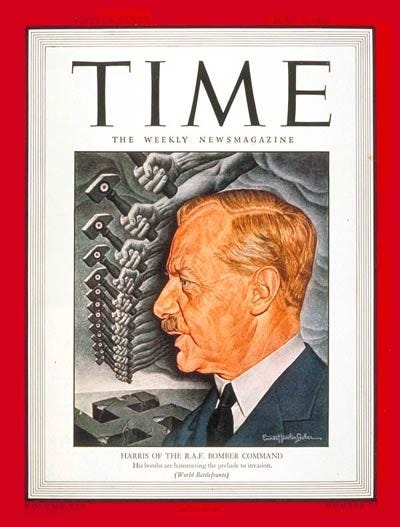
There was nothing out of the ordinary about the Time magazine issue that hit newsstands on June 7, 1943. The cover illustration showed Arthur “Bomber” Harris, the irascible RAF Commander then leading the Allied bombing campaigns against Nazi Germany, bringing the hammer down on a crumbling swastika. Inside the magazine, between warmongering advertisements—Caterpillar Tractor Company: “Maybe you overlooked this machine when you planned your world conquest, Adolf”—there were digestible reports from the war’s many battlefronts; requests for readers to buy war bonds and war stamps; a report on “the new wonder drug” Penicillin; a long obituary of Edsel Ford, president of Ford Motor Company; and a capsule review of the latest morale-boosting turkey, Action in the North Atlantic, starring Humphrey Bogart and Raymond Massey.
It was strange, then, to find wedged in the magazine’s back half a three-page unsigned review of T. S. Eliot’s Four Quartets, which had just been published by Harcourt & Brace. “In a little short of 900 lines,” the review began, “these subtle, magnificent religious poems contain more beauty and sense than any book within recent memory.” But what did beauty and sense matter to Time’s middlebrow readers, concerned first and foremost with the progress of a war America had entered just eighteen months earlier? Who among them did Time—or Harcourt, for that matter—imagine were going to go spend $2 (about $35 in today’s currency) on forty-four pages of high modernist poetry?
On the second page devoted to the review, next to a Louden Machinery ad on “how to use women to solve the manpower issue,” the authors attempted a little exposition for the benefit of the reader:
The sere, cryptic titles of the four quartets are the names of places intimately associated with [Eliot’s] experience. Burnt Norton was a Gloucestershire manor near which he lived for a while. East Coker is a Somerset village which was the home of his ancestors. The Dry Salvages (accented like assuages) is a group of rocks off Cape Ann, Mass. Little Gidding was a 17th-Century religious community established by Nicholas Ferrar. Each of the poems has not only its earthly-mystical locals but its season of the year and its Aristotelian element as well—which is not in every case clear.
An obvious concession to the taste of the two writers who’d drafted it together, the review of Four Quartets marked a small yet significant moment in literary history: the only occasion on which James Agee and Weldon Kees worked together on a text.
At first glance they seemed polar opposites—walking embodiments of Philip Rahv’s famous distinction between paleface and redskin writers. At thirty-three, Agee was already a veteran of Henry Luce’s Time Inc. empire, having previously served as a reporter for Fortune, where he was known to show up to work in soiled sneakers and ragged pants, constantly trying the patience of his editors by submitting 30,000-word drafts of his articles. A fount of endless talk and open-book agonies, a pill swallower and problem drinker, his life always in great disarray—in 1943 he was living with the woman who would become his third wife—Agee wrote the weekly movie column for Time and also served as The Nation’s film critic, a position that, by then, had won him a cult-following. (In a letter to The Nation, W. H. Auden called Agee’s column “the most remarkable regular event in American journalism today.”) Let Us Now Praise Famous Men, the confounding but brilliant prose work about the plight of Southern tenant farmers that Agee, with the aid of Walker Evans’s photographs, had spun from a 1936 Fortune assignment, was published in book form in 1941. It was a critical and commercial failure.
In contrast to Agee, the twenty-nine-year-old Weldon Kees looked like he’d just strolled off the set of a film noir. He was dark-eyed, debonair, and with his trim mustache and wide-set eyes, faintly resembled the actor Lee Van Cleef. A Nebraska native, Kees had spent several years working for the Federal Writer’s Project in Lincoln, before departing for the University of Colorado in Denver, where he trained as a librarian and began seriously writing short fiction. Throughout the second half of the 1930s, his stories were routinely published in little magazines like Prairie Schooner, Horizon, the Rocky Mountain Review, and New Directions. A novel, Fall Quarter, was making the rounds among editors, though by the time he moved to New York in 1943, Kees had refashioned himself as a writer of formally taut, coolly disillusioned poems, many of which appeared in the pages of Partisan Review, The Kenyon Review, and eventually The New Yorker. “An intuitive cosmopolitan,” in Michael Hofmann’s words, Kees had a mercurial, Zelig-like ability to turn up at all the right places and meet all the right people. He befriended Dwight and Nancy Macdonald, had dinner with Mary McCarthy and Edmund Wilson, went to Yaddo with Carson McCullers and Malcolm Cowley, and once even accompanied Elizabeth Bishop to St. Elizabeth’s Hospital to visit the institutionalized Ezra Pound. Though he would serve only a few months at Time before taking a job at Paramount Pictures, Kees very likely gravitated toward “Jim” Agee, the slightly senior writer with whom, outward differences notwithstanding, he turned out to have quite a lot in common.
*
Born in 1909 and 1914, respectively, James Agee and Weldon Kees were part of a generation of American writers whose early adulthood was shaped by the Wall Street Crash of 1929 and the ensuing Great Depression. “No one who grew up in the Great Depression ever recovered from it,” Alfred Kazin later wrote. Though both Agee and Kees were spared the worst of it, their distinctive regional backgrounds—Agee hailed from Knoxville, Tennessee; Kees from Beatrice, Nebraska—meant that they saw and were affected by their share of poverty and privation. In his short fiction, Kees returns again and again to the fictional town of Weston, Nebraska, where his lonely characters lead lives of quiet desperation. In “Gents 50¢ / Ladies 25¢” (1937), a high school girl selling tickets at the local dancehall gets “a funny uncomfortable feeling she couldn’t understand” when three undernourished women, whose husbands all work the night shift at the local factory, show up and stand by the fence to watch the dancers. “She wished that they would go away. She didn’t like them being around.” In “Mrs. Lutz,” the proprietor of a local diner swipes her own employee’s quarter-dollar tip, while in “Letter from Maine,” an ageing widower feuds with his daughter-in-law over a send-a-dime chain-letter scheme.
Perhaps it is the realization of the hollowness of the American dream that most informs Kees’s work. The tone of his best writing, which is his verse, oscillates between the wryly sardonic (“Iron, sulphur, steam: the wastes, / Of all resorts like this have left their traces. / Old canes and crutches line the walls,” begins the poem “Saratoga Ending”) and the inconsolably bleak, like the poem “For My Daughter” which ends: “I have no daughter. I desire none.” In whatever form he chose, Kees was able to describe at a distance, with unnerving calmness and precision, the doom and gloom of a whole generation for whom the optimism and prosperity of the Roaring Twenties were transformed overnight into “the fragments of a world / Dropping to pieces like a sick bouquet.”
James Agee, too, drew heavily on his Knoxville upbringing in his writing, not only in the posthumous A Death in the Family (1957) or the story “Knoxville: Summer of 1915” that appeared in Partisan Review in 1938, but also in the assignments he wrote for Fortune. In 1933, he reported on the Tennessee Valley Authority (TVA), the federally-owned electric utility corporation that was created as part of President Roosevelt’s New Deal. The article opens with a sweeping description of the land and its people—the “fine soft slur in the streets” and the “far-falling river constant in its course”—before evolving into an extremely well-judged account of the possibilities and responsibilities of the TVA as a federal response to the Great Depression. Above all, it showcases the author’s sublime verbal dexterity. The fact that his literary debut, 1934’s Permit Me Voyage, was a book of stilted, affected verse may lead one to believe he was a poor poet. In fact, he was a great one, in prose: “The mountains are profoundly muscled with some forty of the minerals most useful to man,” for instance, is a sublimely affecting line. If Kees had some of the reticence and economy of fellow Midwesterners like Sherwood Anderson, Agee’s prose had the loose, limber strides of Whitman and Twain.
While the Depression was the central political-historical event of their youth, literary modernism was its artistic correlative. Kees in particular was every inch a man of what his friend Hugh Kenner later called the Pound Era. To some, it made him seem a little old-fashioned. “Weldon,” Alfred Kazin wrote, “was born too late for the literary modernism that flourished in the first decades of this century and became academic business to our generation.” Similarly, as a young Southern writer finding his own voice, Agee had to contend with the twin pillars of American Southern prose at the time: William Faulkner and Thomas Wolfe. 1929 saw the publication of both The Sound and the Fury and Look Homeward, Angel, novels whose influence was inescapable, even if it was an influence Agee sometimes resented. “I feel as though he had stolen my whole childhood,” he once remarked of Wolfe.
What literary modernism above all bequeathed to both Agee and Kees was an uncompromising belief in the integrity and inviolability of art. A 1941 notice in the Nebraska State Journal said of Kees that “he refuses to compromise with art as he understands it. He’ll stick like a burr to his ideals of writing and consider their cold perfection more satisfying than a certified check.” Agee could be similarly high-minded. During a meeting with Houghton Mifflin ahead of the publication of Let Us Now Praise Famous Men, he suddenly asked that the book be printed on newsprint. “But Jim, in five or ten years it’ll powder up,” Pete Brooks, the editor in chief, told him. “That might be a good idea,” Agee earnestly replied.
And yet, though they glorified artistic and intellectual autonomy, both Agee and Kees soon became what C. Wright Mills called “the hired men of the information industries.” In a contribution to Partisan Review, Kees wrote that “a whole generation of ‘promising talents’ examines its graying hairs and pouchy eyes in the cubicles of the O. W. I., the Time and Life Building, or in the scenario department at MGM.” He might have been describing Agee and himself. After his brief stint at Time, Kees took a job producing newsreels at Paramount Pictures that he would keep for four years. Agee spent well over a decade writing for Time, Life, and Fortune, a career he was deeply ambivalent about as it went against his natural antipathy toward bourgeois society: “It varies with me from a sort of hard, masochistic liking without enthusiasm or trust, to direct nausea at the sight of this symbol $ and this % and this biggest and this some blank billion,” he wrote. “But in the long run I suspect the fault, dear Fortune, is in me: that I hate any job on earth, as a job and hindrance and semisuicide.”
Nevertheless, the time Agee and Kees spent working for corporate culture producers was hardly wasted. At Paramount, Kees made decent money writing newsreel scripts, calling it, in a letter to his father, “as good a way of making a living as any I know.” He quickly earned a promotion and was especially proud of the work he did on the newsreel footage that had come in from Hiroshima in 1945. To the Shores of Iwo Jima, the newsreel Kees edited about the eponymous battle, was reviewed in The Nation by—whom else?—James Agee, who called it “an unusually intelligent job of editing, writing, and soundtracking.” According to Kees’s biographer James Reidel, Agee heard about the newsreel from Kees himself at a party given by Agee’s sister in the West Village.
Agee, meanwhile, plainly did some of his best writing at the behest of Henry Luce’s magazines. His 1934 descent into the subterranean world of cockfighting on behalf of Fortune belongs in any anthology of American sports writing worth its name. (“A gamecock, confronted by any rival rooster, will ignore the most alluring hens, the most delicious food, while he glares with beady hatred at his instinctive enemy for days on end”—my emphasis). In a Time review of William Carlos Williams’s In the Money, Agee writes that “Williams in his best verse gives the simple objects of existence the glistening integrity of pebbles in a quick stream.” Whatever the occasion, Agee rose to it. The historian Robert Vanderlan, in his excellent study Intellectuals Incorporated: Politics, Art, and Ideas Inside Henry Luce’s Media Empire (2010), is clearly right to fault Agee’s obtuse biographer, Laurence Bergreen, for failing even to try to understand why Agee worked so hard at a job he supposedly despised.
Yet even among these “interstitial intellectuals,” to borrow Vanderlan’s term, Agee and Kees stood out for the simple reason that they were not intellectuals in the typical midcentury sense of the term. Though both were friends of Dwight Macdonald’s, they remained peripheral at best to the debates being fought among the Politics or Partisan Review crowds. Instinctive rather than committed leftists, they were not primarily interested in politics or ideas. “I am […] much too dependent in my work on feeling, as against ‘intellect,’” Agee wrote in a letter to the poet and translator Robert Fitzgerald. Kees said he felt “too little sense of ‘belonging’ with my contemporaries,” even as he socialized with the best of them. Part of this resistance to the atmosphere of dialectical ingenuity and sectarian aggression that characterized the intellectual climate must also have been the suspicion that life was lived outside the mind, too. Perhaps it is for this reason that neither Agee nor Kees ever expressed any interest in America’s burgeoning English literature or creative writing departments to which so many of their peers slinked in search of gainful employment.
In the end, what really distinguished Agee and Kees from many of their peers the New York Intellectual crowd, save perhaps for Delmore Schwartz, was their genuine interest in popular culture, especially Hollywood. Agee was the more successful in this regard; after giving up regular film reviewing in 1948, he began to spend more time in California, writing a profile of the director John Huston and eventually helping him write the screenplay for The African Queen (1951). In 1954 Agee was hired to write the screenplay for The Night of the Hunter, an assignment he completed while holed up at the Chateau Marmont, a bottle of Jack Daniel’s always close to hand. When he turned in his 350-page script, the film’s director, Charles Laughton, had to rewrite it while Agee apparently “drank himself into a two-week long stupor” at the home of the film’s producer, Paul Gregory.
Kees, whose childhood friend was the actor Robert Taylor, had gone out to Hollywood as early as January 1936 to try and “make it” while waiting for word from publishers about his novel Slow Parade (when word arrived, Kees abandoned the manuscript). Though he returned empty-handed to Nebraska later that summer, Tinseltown remained an obsession. He wrote stories set in Hollywood and, in both his fiction and poetry, showed the clear influence of cinematic techniques. The surrealist Americana of “The Evening of the Fourth of July,” a story that appeared in New Directions in 1940, foreshadows the writing of William Burroughs and Don DeLillo, while the four so-called “Robinson” poems, which follow an urbane midcentury everyman, Don Draper in embryonic form, use montage brilliantly. The most memorable of these, “Aspects of Robinson,” unfolds scene-like, then quickens to a snapshot-tempo with devastating effect:
            Robinson walking in the Park, admiring the elephant.
            Robinson buying the Tribune, Robinson buying the Times.
                        Robinson
            Saying, “Hello. Yes, this is Robinson. Sunday
            At five? I’d love to. Pretty well. And you?”
            Robinson alone at Longchamps, staring at the wall.
The poem builds toward a flash of crisis—“Robinson afraid, drunk, sobbing Robinson / In bed with a Mrs. Morse. Robinson at home; / Decisions: Toynbee or luminol?”—before retreating slightly—“Robinson in Glen plaid jacket, Scotch-grain shoes”—as perhaps Robinson’s moment of crisis passes, his “sad and usual heart, dry as a winter leaf” once again assuming its armor of proper attire.
It is an open question whether, or to what degree, Robinson is a self-portrait. Certainly Kees was no stranger to the quiet terror barely concealed behind an unruffled demeanor. Though absurdly multitalented—he was also an abstract painter of some renown, a discerning jazz critic, a composer of music, and a stage show impresario—he was also agonizingly unlucky. His third book of poems, which contained much of his best work, had been rejected more than twenty times. By the early ’50s, living at continent’s end in San Francisco, Kees “had nearly disappeared from every avenue of America’s literary life,” reports Reidel.
Unlike Agee, who has achieved a measure of posthumous fame due to the belated acknowledgment of Let Us Now Praise Famous Men as a masterpiece and the publication of his novel A Death in the Family, which won the Pulitzer Prize in 1957, Kees remains a writer whose work travels by word of mouth among readers, and whose flame has been kept alive by a handful of dedicated individuals: Donald Justice, who edited his Collected Poems in 1960, Reidel, whose Vanished Act: The Life and Art of Weldon Kees was published in 2003, the poet Dana Gioia, who edited a selection of Kees’s short fiction, and Robert E. Knoll, who in 1986 put together a selection of Kees’s letters with wise and judicious commentary throughout.
Of these, only Reidel comes close to intuiting the curious correspondence of Agee and Kees’s lives and work. In Vanished Act, he refers to half a dozen or so encounters between the two writers, not only at the Time offices or in New York bars, but also across the country in Los Angeles. In 1950, for example, Kees was at a party somewhere in Hollywood with Agee, whom he described as having the most “enormous & quickly developed potbelly now worn by any US man of letters of his generation.” A few months later, Kees and his wife dined with Agee, who “seemed in good form” despite a recent heart attack. Elsewhere, Reidel mentions “a book of famous suicides subtitled How-Not-To-and-Why-Not-To-Do-It” that Kees and Agee supposedly discussed writing together, as well as a collection of soldiers’ letters they wanted to edit. (In contrast to Reidel, Laurence Bergreen doesn’t mention Kees at all in his 1983 biography, James Agee: A Life, and seems not to have even been aware of his existence.)
Maybe the reason Agee and Kees’s relationship remains unexplored is because what they had in common most of all was not what they achieved, but what they didn’t achieve, at least while they were still alive. Agee, despite health problems and warnings from doctors, maintained his suicidal drinking. Kees, depressed by publishers’ lack of interest, fell back on recurring fantasies of disappearing to Mexico or following in the footsteps of Hart Crane, who died by apparent suicide in 1932. To each his own demons. In the end, Agee and Kees were two American originals whose careers ended in spectacular, American-writerly fashion: after years of abusing drink, Agee suffered a massive and this time fatal heart attack in the back of a New York taxicab on May 16, 1955. Two months later, on July 19, the California Highway Patrol found Kees’s 1954 Plymouth abandoned on the northern approach to the Golden Gate Bridge in San Francisco. No one knew where he’d gone, and no one ever saw him again.
Morten Høi Jensen is a Danish-American writer and critic. He is the author of A Difficult Death: The Life and Work of Jens Peter Jacobsen (2017) and The Master of Contradictions: Thomas Mann and the Making of The Magic Mountain, which will be available from Yale University Press in October.
Support Nimrod by subscribing today!